
Hakuba Norikura Onsen Snow Resort Overview
白馬乗鞍温泉スキー場Hakuba Norikura Onsen, known locally as 'Hakunori', sits at the northern end of the Hakuba Valley in Otari, Nagano, and a shared lift ticket links it to neighbouring Hakuba Cortina. It has 16 courses across roughly 520 metres of vertical and 50 hectares, with wide beginner pistes, tree skiing and an onsen at the base. The snowfall is the same heavy Sea of Japan snow that makes this corner of the valley a powder favourite.
Resort Location
Location of the resort on the map of Japan.
Resort highlights
- Access
- Terrain park
- Terrain
- Steep terrain
- Onsen
- Open-air onsen Family onsen Ryokan stays Onsen nearby
- Season
- Long season Late closer
Snow Report
Snow Report →Average peak depth and the month it arrives, over every recorded season.
Typical base at the deepest half-month.
MeasuredClear skies
The share of a typical winter that is clear here, and the months the clear days fall in.
They lean late: close to half of them arrive in March. Across the 34 resorts tracked here, a typical winter holds between 2 and 11 clear days.
Checked against sunshine measured at Hakuba. The same station validates Hakuba Cortina Snow Resort, Hakuba Goryu & Hakuba47, Hakuba Happo-One Snow Resort, Hakuba Iwatake Snow Field and Tsugaike Mountain Resort.
How a winter day is classified
Winter runs from December 1 to March 31. A day counts as Clear when modelled cloud cover is 30% or less, Partly Cloudy from 31 to 79%, and Overcast from 80% up. A day with 5 cm or more of snowfall counts as Snow, whatever the cloud cover.
Cloud cover comes from the ERA5 reanalysis for the weather cell this resort sits in. It is checked against hours of sunshine measured at the nearest reporting station, lower down the valley.
The modelled cloud is compared with the station’s measured sunshine on the 3,243 winter days that have both. When the two agree poorly, the clear-day figure is given as a range instead of a single count.
The classification describes cloud over the resort’s weather cell, but nobody measures visibility on the hill. A cell that reads clear can still leave the upper mountain in cloud all day.
Mountain
Mountain →The spread from this mountain’s gentlest run to its steepest, ranked against the other mountains with pitch data.
Its runs range from 6.7° to 21.4°.
EstimatedLifts
Every active lift, ranked by the riders it carries uphill in an hour.
9 active lifts carrying skiers uphill.
EstimatedRiders per hour (estimated)
Lift Tickets
Lift Tickets →The cost of an hour on the hill, for every ticket length.
Cheapest cost per hour among the compared passes.
MeasuredGetting Here
Getting Here →One recommended public-transport route from each gateway city.
3 gateway cities with a confirmed public route.
Measured- Tokyo → Nagano Station (Shinkansen) + bus: board:Tokyo Station — Tokyo Station — (北陸新幹線, 85 min) — Nagano Station — (長野白馬線(特急バス), 130 min) — Hakuba Norikura
- Shinkansen via Nagano + Alpico bus (from Tokyo Haneda): Tokyo Haneda Airport — (東京モノレール, 15 min) — Hamamatsucho — (山手線, 10 min) — Tokyo Station — (北陸新幹線, 85 min) — Nagano Station — (長野白馬線(特急バス), 130 min) — Hakuba Norikura
- Airport bus + Shinkansen via Nagano + Alpico bus (from Toyama): Toyama Airport — (富山空港連絡バス, 25 min) — Toyama Station — (北陸新幹線, 55 min) — Nagano Station — (長野白馬線(特急バス), 130 min) — Hakuba Norikura
Videos
Videos →Riders’ own words from their videos, each with its timestamp.
5 rider clips from confirmed videos.
Creator-sourced-

“the upper part of Rabbit are great warm-up trails while Kamushka course is a bit more challenging. If Alps number nine lift is running, Satami Ridge is a black trail”
-

“次は中上級者が周回するコース。まずは上級のハイウェイコースから詰めろう。リフトを降りてすぐに向かう斜面は本来ならばモフモフのオフピステコースなのかな。 天気の兼合いで今日は営業終了紛らの ピンコースっぽくなってるね。”
-
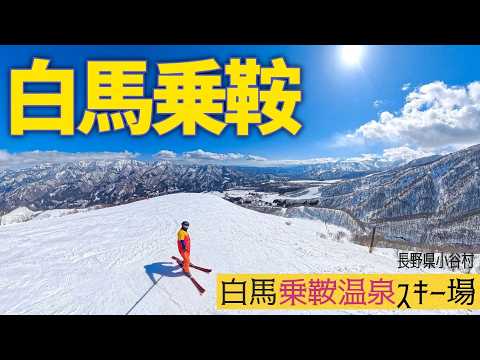
“ちょっと曇ってきましたね。というわけで、え、白ファミリーコース打ってきます。はい。ここです。もうこのリスト1本分ずーっといくね。初級車コースです。初心者コースです。はい。他のね、中級コースのとは完全に分離されてるんで”
-

“ばいばいばいこっち上がってはいこちらハイウェイコースからのハイ フォグラダーある値告知境界杭んでねはいちょっとここを楽しみましょう”
-

“白馬乗鞍温泉スキー場は、多様なコース展開と温泉施設が魅力です。 若栗中央ゲレンデは初心者やファミリー向け、”