Driving in Japan in Winter: What the Crash Data Says Before You Rent
A data-led read on winter driving to eight Japanese ski resorts: where and when crashes actually happen on each approach road, plus how to read snow and ice, a deep pre-drive checklist, and what to do when the road turns, backed by official guidance.
If you are planning your first Japan ski trip, you have probably wondered how hard the winter driving really is. The honest picture sits between the horror stories and the shrug: on certain roads and in certain conditions the risk is real and measurable, and on most winter days it is manageable. The difference is specific, and it lives in the crash data.
Renting is a real trade-off: first tracks and the freedom to chase snow, in exchange for owning the driving on unlit passes and refrozen ice. Most winter guides answer that with the same tips list, studless tyres, keep your distance, clear the roof. Useful, and we get specific later. But the thing that should actually shape your decision is the one nobody else publishes: where and when the crashes on these exact roads happen. We pulled that, resort by resort. Read it before you decide whether to drive at all.
How risky is it, really?
The honest answer: riskier than the tips lists imply, less dramatic than the horror stories. The country is not the problem; a specific mix of conditions is, and that mix is predictable enough to plan around.
We built this because the winter-driving advice out there is all vibes and no numbers, and your safety on these roads deserves better than a generic tips list. So we matched Japan’s National Police Agency crash records1 to the actual approach roads for these eight resorts, across six winters (2019–2024), and looked at how often crashes happened in snowfall, at night, and with a single car losing control. Two caveats: it samples the main corridors rather than every crash, so read it as where risk concentrates; and it is for planning, not live conditions, so check official sources for your actual day.2
With that said, three patterns do most of the work.
Three things the crashes have in common
Across all eight resorts, the same three signals keep separating the harder roads from the easier ones.
Crashes cluster when it is actively snowing. Some roads see most of their crashes on clear days; others almost entirely mid-snowfall. A high share here means the hazard is the weather, not the road, and the fix is simple: do not drive through a snowfall you can wait out.
A lone-car crash points at the road, not the weather. One car, no other vehicle, is the cleanest sign the driver simply lost control: a slide on a curve, a misjudged downhill, a wheel off the shoulder. A high share here means the road’s own geometry and surface are enough to catch people out, whatever the sky is doing. Worth knowing before you picture a mountain hairpin: the highest well-sampled share in this data sits on an expressway, not a pass.
Darkness makes everything worse. Sunset refreezes slush into ice and swallows your headlights in falling snow. A high night share points at one rule above all others: arrive before dark.
Here is how the eight resorts compare on their busiest approach road.3 The three percentages below are, in order, the snowfall share, the lone-driver share, and the night share.
| Resort | Region | Crashes during snowfall | Lone-driver crashes | Crashes after dark | Approach climb | Heavy-snow days / season |
|---|---|---|---|---|---|---|
| Niseko United | Hokkaido | 39.8% | 7.1% | 35.7% | 255 m | 12.8 |
| Furano | Hokkaido | 41.5% | 4.6% | 27.7% | 25 m | 2.6 |
| Tomamu | Hokkaido | 43.8% | 6.2% | 22.9% | 586 m | 3.0 |
| Kiroro | Hokkaido | 47.3% | 5.5% | 40.0% | 503 m | 8.4 |
| Hakuba Happo-One | Nagano | 79.1% | 0.0% | 40.3% | 760 m | 6.9 |
| Tsugaike | Nagano | 65.4% | 1.9% | 46.2% | 800 m | 6.9 |
| Hakuba Iwatake | Nagano | 63.2% | 1.8% | 47.4% | 750 m | 6.9 |
| Zao Onsen | Tohoku | 69.0% | 4.8% | 47.6% | 678 m | 2.5 |
The pattern is regional. The Hokkaido corridors run in the 40–50% band for crashes-during-snowfall; the Nagano and Tohoku corridors sit far higher, roughly 63–79%. That regional split is the clearest read in the data, and it is worth holding onto before the resort-by-resort detail.
Resort by resort: the eight approaches
We covered the three patterns. Here is how they play out on the actual roads to each resort, region by region.
Hokkaido: long drives, dry snow, fewer snowfall crashes
Hokkaido’s crashes are less concentrated in active snowfall than you might expect. The snow is dry and cold, around −7°C on snowfall days across these four resorts, so it blows and packs rather than turning to the slush that catches drivers out further south. The risk here is more about distance and fatigue than any single terrifying stretch.
Niseko United
The default Hokkaido self-drive, usually from New Chitose Airport. On that expressway corridor the snowfall share is the lowest in the whole group, about 40%, but the night share is the highest of Niseko’s routes at roughly 36%, so a lot of people finish this drive in the dark. Across all of Niseko’s corridors the snowfall share ranges from about 40% up to 59% on the national roads from Sapporo. The lone-driver share is the one number here that deserves more attention than it usually gets: at 7.1% on that New Chitose expressway it is the highest in this table, and unlike the larger figures elsewhere in this article it rests on a full sample rather than a thin one. Read it as the road asking something of you even on a clear day. This is still a manageable drive in daylight, and the risk you can most control is not arriving after sunset. Kutchan, beside the resort, logs the most heavy-snow days of any corridor here, roughly 12.8 a season, yet Niseko’s crashes are the least tied to active snowfall: steady, expected snow gets cleared and driven with respect.
39.8% of crashes on this approach happened while it was snowing.
Furano
The gentlest approach in the group, a net climb of just 25 metres, and its numbers reflect that: lone-driver crashes in the low single digits on the main corridors and a modest night share. The one figure to respect is a small-sample expressway route where the lone-driver share jumped to 16%; on a long, straight, snowy expressway, boredom and speed are the enemy, not the terrain.
41.5% of crashes on this approach happened while it was snowing.
Tomamu
The one Hokkaido resort where the data asks for more caution. Its approach climbs 586 metres, and while the snowfall share is moderate (around 44% on the main route), the lone-driver share climbs to 22.2% on the New Chitose national-road corridor. Treat that figure as directional rather than precise: it is one of the small-sample corridors, resting on 27 in-radius crashes. What carries more weight is that the fatal crashes in our Hokkaido sample concentrate on Tomamu’s routes more than on any other resort’s, and that the approach climbs 586 metres. The read: the final climb is where control is lost. Give it daylight, dry conditions, and a slow pace.
43.8% of crashes on this approach happened while it was snowing.
Kiroro
The only resort here inside a 特別豪雪地帯 (special heavy-snowfall area), with roughly 8.4 heavy-snow days per season. Read its numbers carefully, because on the two measures that matter most it is the worst in the Hokkaido group, not the best: the highest snowfall share at 47.3%, and the highest after-dark share at 40.0%.
No fatal crash on its four corridors appears in our sample. That needs stating precisely rather than cheerfully: it means six seasons of main-corridor records did not contain one, which is not the same as these roads being safe. Our sample covers the main roads rather than every crash, a count of zero is the most fragile number any dataset can produce, and one fatal crash next season would erase it. Read it as an absence of evidence, not as evidence of safety.
What the data does support is where to be careful. The final stretch is genuinely mountainous, the curve-and-downhill figures on the Sapporo expressway approach are steep, and 40% of the crashes on the New Chitose route happen after dark. Darkness on the descent is the thing to plan around here.
47.3% of crashes on this approach happened while it was snowing.
Nagano: the resorts where crashes happen in the snow
The three Hakuba-valley resorts share one striking trait: crashes here happen overwhelmingly while it is snowing. The snowfall share runs from roughly 63% to 79%, far above anything in Hokkaido, and the climbs are the steepest in the group (750–800 metres). The snow is wetter and warmer here, with snowfall-day temperatures around −2 to −4°C, so it turns to slush and then to ice more readily.
Hakuba Happo-One
Happo-One posts the highest single figure in the dataset: about 79% of crashes on its Komatsu-airport national-road approach happened during active snowfall, rising to 82.5% on the Toyama route. Lone-driver crashes, by contrast, are very low (0–5%): these are weather crashes on busy roads, not lone slides on empty ones. Night crashes are common on every approach, above 40% on several. The rule for Happo-One is simple: do not drive to it during a snowfall or after dark.
79.1% of crashes on this approach happened while it was snowing.
Tsugaike & Hakuba Iwatake
Right next door, Tsugaike and Hakuba Iwatake tell almost the same story, and it is worth saying plainly: if it is snowing on the way up here, the odds are not with you. Snowfall shares sit in the 60s, up to roughly 79% on Iwatake’s Toyama approach, and these two have the highest after-dark crash shares in the whole dataset, reaching roughly 57% on the Komatsu expressway approaches. On some corridors, more than half of all crashes happen at night. Lone-driver crashes stay low, so again this is weather, not terrain doing you in. For all three Hakuba-valley resorts, the train to Nagano Station plus a local bus skips exactly the stretch the data says is riskiest, and you get to watch the snow instead of fighting it.
65.4% of crashes on this approach happened while it was snowing.
63.2% of crashes on this approach happened while it was snowing.
Tohoku: Zao, and the after-dark problem
Zao Onsen
Zao sits at the top of a 678-metre climb, and the thing that makes it famous is the thing that makes the drive up hard. Zao’s 樹氷 (juhyo), the frost-caked “snow monsters,” form when supercooled cloud freezes onto the trees near the summit. That same freeze-on-contact air glazes the approach road, so the drive ices along with the mountain.
The data backs the reputation. After-dark crashes are among the highest here, from about 34% up to about 48% of the total depending on the route, and the snowfall share is high, roughly 63–70%. One approach even showed a raised lone-driver share, around 11%. High, cold, and quick to refreeze after sunset, Zao is not a no-go; it is a daylight-and-settled-weather drive. Clear afternoon, and the climb is ordinary. Falling snow after dark, and you are driving the exact conditions behind most of those crashes.
69% of crashes on this approach happened while it was snowing.
Know what you are driving on
Not all winter road is the same, and the surface changes faster than most first-timers expect, sometimes within a single corner. Learning to read it is half of driving it safely. These are the surfaces you will meet on a Japan ski approach, roughly in order of how much they should scare you.
What packed snow, ice, and low visibility actually look like from behind the wheel in Hokkaido (creator Jeremy Toh).
Fresh powder (新雪). Light, dry, new snow on top of the road. It looks the worst and is often not the worst, because there is texture for the tyres to bite. The danger is what it hides: a powder dusting over ice gives you almost no warning. Treat fresh snow as an unknown surface until you feel the grip.
Packed snow (圧雪). Snow compressed by traffic and ploughs into a firm white layer. This is the normal surface on Hokkaido resort roads, and while it is cold and dry it actually offers decent, predictable grip on studless tyres. It turns treacherous the moment it warms toward melting or gets polished smooth.
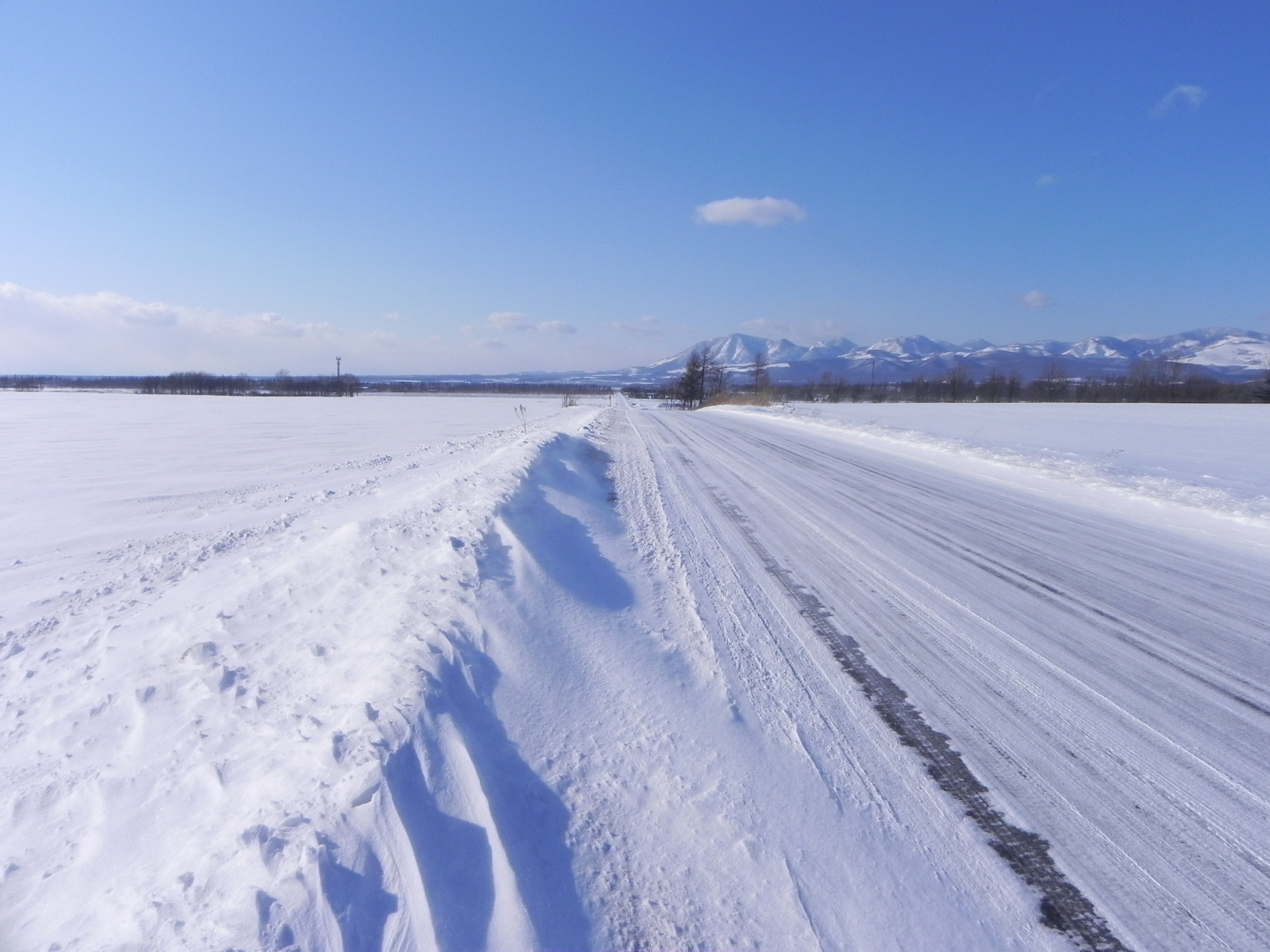
Slush (シャーベット状). Half-melted, wet snow, common on the warmer Nagano and Tohoku approaches and around midday. It drags at the steering, hides depth, and can pull the car sideways if one side hits a deeper patch. Slush that refreezes after sunset becomes the next surface on this list.
Icy and frozen road (凍結路面). A hard, often glossy layer where snow has melted and refrozen. Grip drops sharply. Bridges, tunnel entrances, shaded bends, and anywhere near a river or the top of a climb freeze first and thaw last. If the road ahead looks wet on a sub-zero day, assume it is ice.
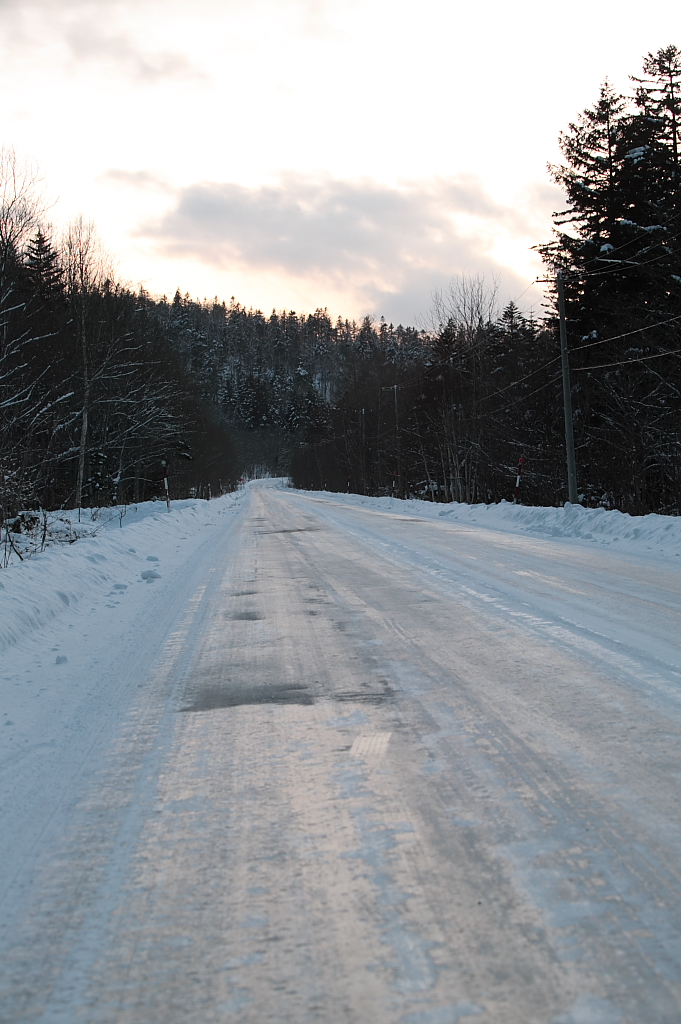
Black ice and mirror-bahn (ミラーバーン). The two that catch experienced drivers. Black ice is a thin, transparent glaze that looks like plain wet tarmac; it forms after sunset, in shade, and on bridges. “Mirror-bahn” is packed snow polished to a mirror by thousands of tyres, usually at intersections, bus stops, and the bottoms of hills where cars brake. Both offer almost no grip and give almost no visual warning. When conditions are right for them, slow down before you think you need to.
The practical takeaway is not to memorise Japanese terms, it is to expect the surface to change and to trust feel over appearance. A road that looks merely wet on a freezing afternoon is the one that will surprise you.
Before you drive: the checklist
If you are driving, prepare for the drive you might get, not the one you hope for. Work through this before you leave the rental counter, and again the morning of a mountain day.
The pre-drive checklist
0/18 done
If the road turns: what to do in the moment
Even a well-prepared drive can hit ice or a whiteout. The responses below are the standard guidance published by Japan’s motoring and road authorities, the Japan Automobile Federation (JAF), the expressway operators (NEXCO), the National Police Agency, and the Japan Meteorological Agency.2 Read them before you need them, and treat official guidance for your actual day as the final word.
How a car actually behaves on snow and ice, and how to separate steering, throttle, and braking (Team O’Neil Rally School).
On black ice or a skid, come off the accelerator, and do not brake hard or yank the wheel. Sudden inputs are what turn a slide into a spin. Steer gently in the direction you want the front of the car to go and let the car slow itself. This “no sudden inputs” principle is the core of the skid-recovery advice JAF and the road operators publish.2
On a snowy downhill, use the engine and a low gear to hold your speed rather than riding the brakes. Continuous braking on ice can lock a wheel and cost you steering entirely, which is why engine braking is the standard recommendation for long descents.2 Pick your slow speed at the top, not halfway down.
In a whiteout, if you genuinely cannot see, the guidance is to get off the road, into a car park, rest area, or wide pull-off, put your hazards on, and wait well clear of the traffic lane.2 Creeping forward blind is how chain-reaction collisions start. The Meteorological Agency issues blizzard and heavy-snow warnings precisely so you can avoid being caught out; heed them.
If you get stuck or are stopped in snow, keep the exhaust pipe clear at all times to prevent carbon-monoxide building up in the cabin, a specific and repeated warning from Japanese authorities during heavy snowfalls.2 Run the engine only intermittently for heat, make the car visible, then call for help and stay with the vehicle.
None of this replaces official guidance for the day you actually drive. It is a starting point. Check JAF, the expressway operators, and local authorities for live conditions and rules, every time.
If you actually crash
Two things surprise foreign drivers here, and both cost money or worse.
You must call the police. Every time, including when you hit nothing but a snowbank. Under Japanese road-traffic law, stopping, helping anyone hurt, and reporting the accident to the police are legal obligations, and they apply to both parties and to accidents of any size.4 The instinct after a solo slide on an empty mountain road is to winch the car out and carry on. Do not. That instinct is why this section exists, and it matters most on exactly the roads where our data shows lone-driver crashes concentrate.
No police report usually means no insurance. The police report is what produces a traffic accident certificate (交通事故証明書), and rental insurance and collision damage waivers normally require it. Skip the call and you can find the cover you paid for does not apply.4
The order on the day:
- Stop and make the scene safe. Hazard lights on, and the reflective triangle from your checklist out behind the car. On a snowy bend you are hard to see, and a stopped car is the next crash.
- 119 if anyone is hurt. Ambulance and fire. Do this before anything administrative.
- 110 for the police. Non-negotiable, however minor. Stay until they are done.
- Call the rental company. They will tell you what they need, and they usually need to be told before the car is moved or recovered.
- Get the accident certificate sorted. Ask the police how to obtain the 交通事故証明書 for this report. Your insurer will ask for it.
- Photograph everything before the snow changes the scene: both cars, the road surface, tyre marks, road signs, the wider approach. Exchange names, contacts, and insurance details with the other party.
One warning worth stating plainly: do not agree a private settlement at the scene. Fault ratios in Japan are decided through the insurers and the police record, and a roadside agreement you cannot read is not a good place to accept liability. Let the process run.
And one cost to know before you rent: on top of any excess, Japanese rental companies charge a non-operation charge (NOC) for the time the car cannot be rented out. It is commonly around ¥20,000 if the car can still be driven back and about ¥50,000 if it cannot, and a standard collision damage waiver does not remove it.4 Some companies sell separate NOC cover. Ask at the counter, in the same conversation where you confirm the tyres.
How to check conditions for your actual day
Everything above tells you where risk concentrates. None of it tells you about tomorrow morning. These are the four sources that do, and how to read each one without Japanese.
1. Weather warnings: the Japan Meteorological Agency. JMA publishes warnings on a map at its multilingual warnings page, and the language switcher there covers English, Traditional and Simplified Chinese, Korean and about ten more. Read the three tiers as a go/think/stop ladder:
- Advisory (注意報): conditions worth planning around. Drive, but keep margin.
- Warning (警報): serious conditions expected. This is your cue to move the drive earlier or switch to the train.
- Emergency Warning (特別警報): exceptional. Do not drive.
Check the warning for the municipality your road passes through, not just your destination. The pass between two towns can be under a heavy-snow warning while the resort itself is clear.
2. Chain regulations: NEXCO. When snow is heavy enough, the expressway operators impose a tyre-chain regulation (タイヤチェーン規制) on specific sections, and studless tyres alone are not enough to pass. These follow the severe snowfall bulletins, so a heavy-snow warning on your route is the moment to check whether your road has one. NEXCO Central keeps an English guide to winter regulations and tyre rules.
3. Live road conditions and cameras: iHighway. NEXCO’s iHighway traffic service shows closures and congestion on a map, plus live camera stills from the expressways and rest areas. The cameras are the single most useful thing on this list, because they show you the actual road surface rather than a forecast. Its dedicated winter-conditions layer runs roughly mid-November to mid-April.
4. Hokkaido whiteouts: Northern Road Navi. If you are driving in Hokkaido, the Civil Engineering Research Institute for Cold Region publishes a snowstorm visibility service that maps expected visibility across the island in bands, for the hours ahead rather than only now. You can register for email alerts for a chosen area and visibility threshold. It runs through the winter season only, and the interface is Japanese, but a colour map needs little translation and it is the only source here that forecasts the specific hazard behind Hokkaido’s night-time crash numbers. The same institute also lists the roads closed for the whole winter in English.
A routine that takes five minutes. The night before, look at the JMA warning for your route and decide your departure time from it. The morning of, open iHighway and look at a camera on your road, then confirm no chain regulation applies. In Hokkaido, add the visibility map. At the wheel, the rule from the crash data still governs: if it is snowing hard or the sun is down on a mountain approach, the numbers say wait.2
Framework: when to drive, and when to wait
This is the decision most guides skip. You do not need to be a nervous driver to make it, you need to be honest with yourself about the conditions in front of you. Read it as tiers.
Green, drive if you want to. Daylight, no active snowfall, roads ploughed and visibly gritted, and a forecast that holds for your travel window. This is the large majority of winter days, and a confident driver with winter tyres will be fine.
Amber, think hard and consider the alternative. Light snow falling, dusk approaching, or a mountain final section like Tomamu, Kiroro’s descent, or any of the Hakuba climbs. If you have real snow-driving experience, go slow and give yourself margin. If you do not, this is where the train or shuttle becomes the smart choice rather than the cautious one.
Red, do not drive. Active heavy snowfall, a blizzard or whiteout warning from the Japan Meteorological Agency, or darkness combined with any of the above. On the Nagano corridors especially, this is precisely the condition in which most crashes in our sample occurred. No powder day is worth it. Wait for morning, or take transit and let someone else own the road.
Two rules fall out of the whole dataset. First, arrive before dark. The after-dark crash share is high almost everywhere and highest on the steepest climbs. Second, do not drive through a snowfall you can wait out. The snowfall share, especially in Nagano, says the falling snow is the hazard, not the road underneath it.
These tiers are less our invention than a reading of the official signals the rest of this guide points to: the Japan Meteorological Agency’s blizzard and heavy-snow warnings, the expressway operators’ tyre-chain regulations, and JAF’s road-condition and winter-driving guidance.2
The honest bottom line
Winter driving in Japan is not uniquely dangerous, but it is not something to wave off either. The crash data says the risk is concentrated and predictable: it lives in active snowfall and after dark, and it rises on the steep final climbs. Every one of those factors is something you can plan around. Drive in daylight and settled weather and you are in the safe majority of days. Hit snow or dark on a mountain approach and the smart move is the train or the shuttle, which is where the numbers point anyway.
If you are still weighing car versus transit for your first Japan trip, start with the resort itself and its access options, then decide.

Footnotes
-
出典:警察庁ウェブサイト(交通事故統計情報オープンデータ, PDL 1.0)を加工して作成. Winter-season records, 2019–2024, joined to each resort’s main approach roads. Adapted from the National Police Agency open crash-statistics dataset under the Public Data License 1.0. ↩
-
Winter-driving techniques and warnings summarised here reflect standing public guidance from Japan’s motoring and road authorities: the Japan Automobile Federation (JAF), the expressway operators (NEXCO East/Central/West, road information at driveplaza.com), the National Police Agency (emergency number 110), the Fire and Disaster Management Agency (119), and the Japan Meteorological Agency (気象庁) for snow and blizzard warnings. Always confirm live conditions, closures, and regulations with these sources for your actual travel day. ↩ ↩2 ↩3 ↩4 ↩5 ↩6 ↩7 ↩8
-
Percentages shown in the table are for each resort’s highest-volume approach corridor in the sample. Ranges across all of a resort’s corridors are given in that resort’s section. Corridors with small sample sizes are noted where relevant. ↩
-
Accident procedure reflects Japan’s road-traffic law obligations to stop, aid the injured, and report to the police, together with standard Japanese rental-industry practice on the traffic accident certificate (交通事故証明書), collision damage waivers, and non-operation charges. NOC amounts are the commonly published figures and vary by company; confirm your own contract at the counter. Sources: rental-car-tips.jp, GaijinPot, and Japanese legal-practice commentary on NOC. Always follow the instructions of the attending police officer and your rental company on the day. ↩ ↩2 ↩3
FAQ
Is it safe to drive in Japan in the winter?
It depends far more on the day and the hour than on the country. On the approach roads to the resorts we track, crashes cluster heavily while snow is actively falling and after dark. A clear morning on a ploughed expressway is one thing; a heavy-snow night on an unlit mountain road is another. The practical answer is conditional: drive in daylight and settled weather, and switch to the train or a shuttle when snow is actively falling or the sun has set.
Do I need winter tyres to drive in Japan?
In snow regions, yes. Rental cars in Hokkaido and the Nagano ski areas are normally fitted with studless winter tyres by default over the season, but confirm it explicitly when you book rather than assuming. Summer tyres on a snow-covered road are the single most common reason a car cannot stop or climb. Always check the current rules with your rental company and official sources before you drive.
Is it better to drive or take the train to a ski resort in Japan?
For the Nagano resorts (Hakuba Happo-One, Tsugaike, Iwatake), the train-plus-bus route via Nagano Station removes the highest-risk part of the trip, the snowy final mountain roads, where our data shows crashes are most concentrated in active snowfall and at night. For Hokkaido resorts, a car buys flexibility but you own the driving risk. If your snow-driving experience is limited, the transit option is the lower-variance choice.
What is a heavy snowfall area (gousetsu chitai) designation in Japan?
It is an official designation for regions that receive enough snow to warrant special infrastructure and budget. Among the eight resorts here, only Kiroro sits in a 特別豪雪地帯 (special heavy-snowfall area). No fatal crash on its approach roads appears in our six-season sample, but that is an absence in a sample of main corridors rather than evidence the roads are safe. On the measures the sample does support, Kiroro posts the highest snowfall share and the highest after-dark share in the Hokkaido group.
Should I avoid driving at night in the snow in Japan?
Night is one of the three patterns that show up again and again in the crash data, and on several corridors (Zao, the Hakuba approaches, Kiroro from New Chitose) the after-dark share of crashes is high. Cold refreezes wet roads into black ice after sunset, and headlights wash out in falling snow. Arriving before dark is one of the cheapest safety decisions you can make.